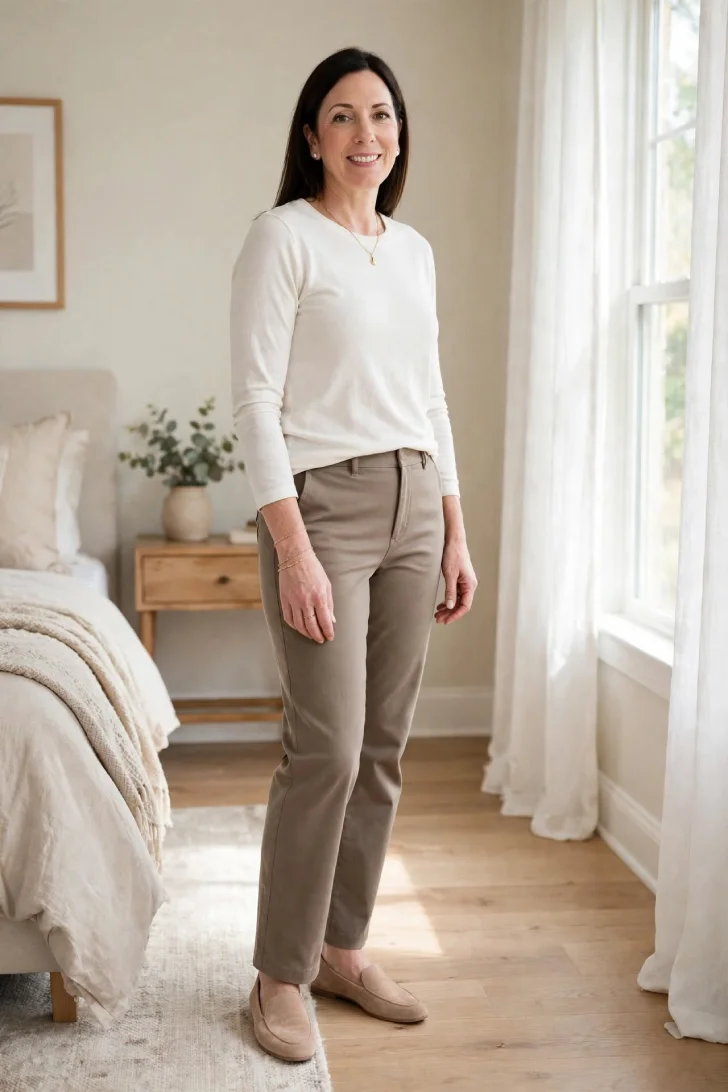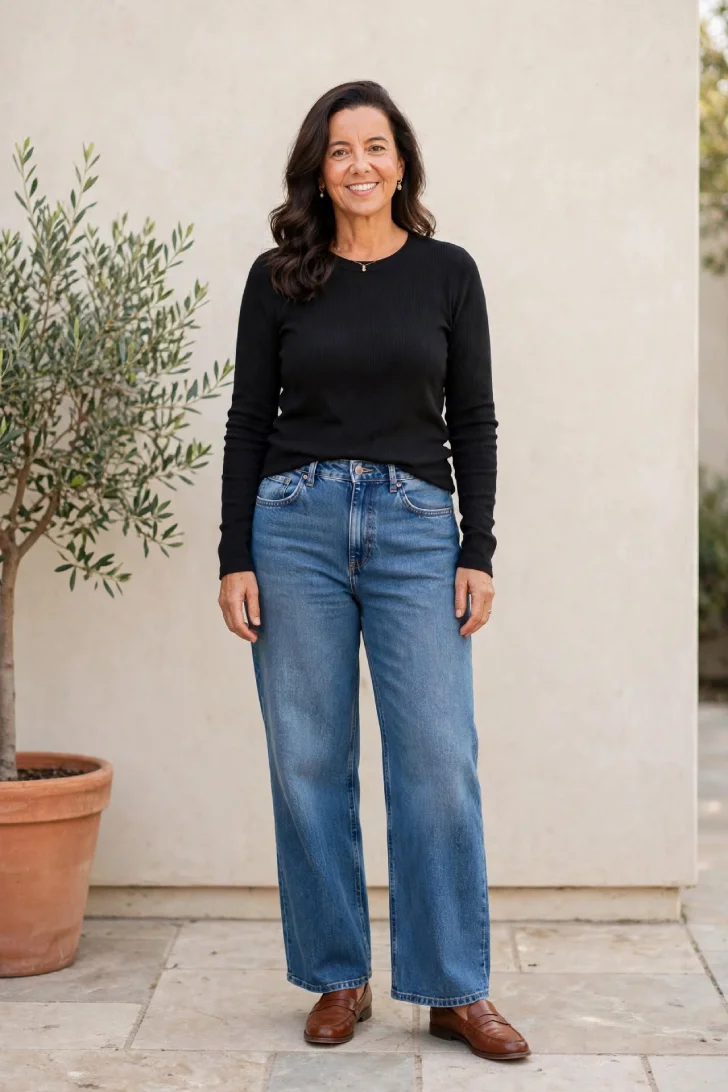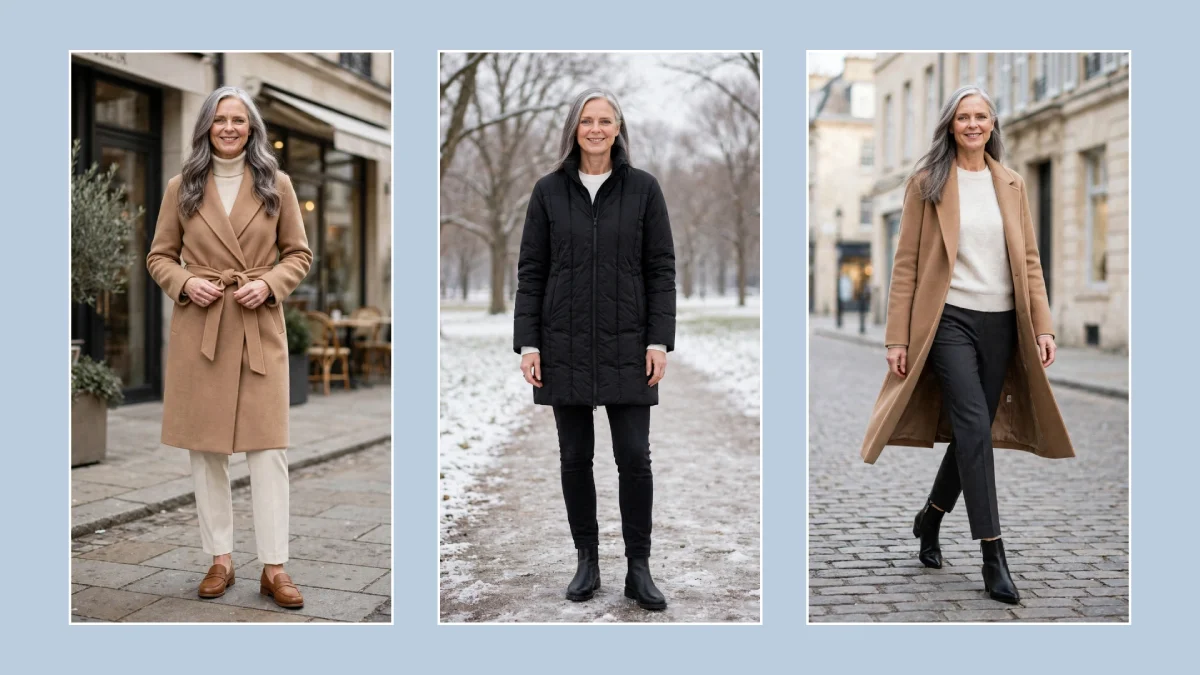

A winter coat should keep you warm without adding ten pounds to your frame. Yet most of us have stood in front of a mirror in a puffy, boxy coat and thought, who is that?
The usual advice is to buy a slimmer coat. That helps, but it rarely solves the problem. The bulk often comes from where the hem lands, how the shoulders fit, and what you pile on underneath. A coat that looks great on the hanger can feel like a sleeping bag once you add a thick sweater and a giant scarf.
Jump to an idea (9)
- 1. Pick a Coat That Ends at Mid-Thigh or Mid-Calf, Not the In-Between Spot
- 2. Check the Shoulder Seam Before You Check the Price Tag
- 3. Wear Slim Layers Under a Roomy Coat Instead of Chunky Ones
- 4. Belt a Wool Coat at Your Natural Waist
- 5. Choose Puffers With Wide Baffles Instead of Tiny Quilting
- 6. Go One Tone From Neck to Ankle Under a Camel Coat
- 7. Swap the Big Scarf for a Slim Wrap at the Neckline
- 8. Let Slim Ankle Boots Balance a Long Coat
- 9. Choose Fabrics That Drape Instead of Puff Up
- The Short Version Before You Head Out the Door
The good news is that winter coats outfits for women over 40 do not need a full wardrobe reset. A few small choices change the whole shape. Hem length, belt placement, and the thickness of your layers matter more than the brand or the price tag.
Here are nine specific moves you can use this week. Save the ones that fit your coat closet and skip the rest.
1. Pick a Coat That Ends at Mid-Thigh or Mid-Calf, Not the In-Between Spot

Hips are where most coats go wrong.
A hem that stops right at the widest part of your hip draws a line across it, and the eye reads that as extra width. Go a few inches shorter, to mid-thigh, or longer, to mid-calf. Both give the eye a clean vertical line to follow. Check it in the mirror with the coat buttoned and your arms relaxed, because a hem can sit differently once you start walking. If you are petite, mid-thigh is usually the easier win, since a very long coat can swallow your legs.
Mid-thigh hem with slim pants or leggings.
Mid-calf hem with ankle boots and a visible gap of leg.
A hem that lands right at the widest part of your hip.
A long coat with a skirt or dress that peeks out unevenly.
2. Check the Shoulder Seam Before You Check the Price Tag
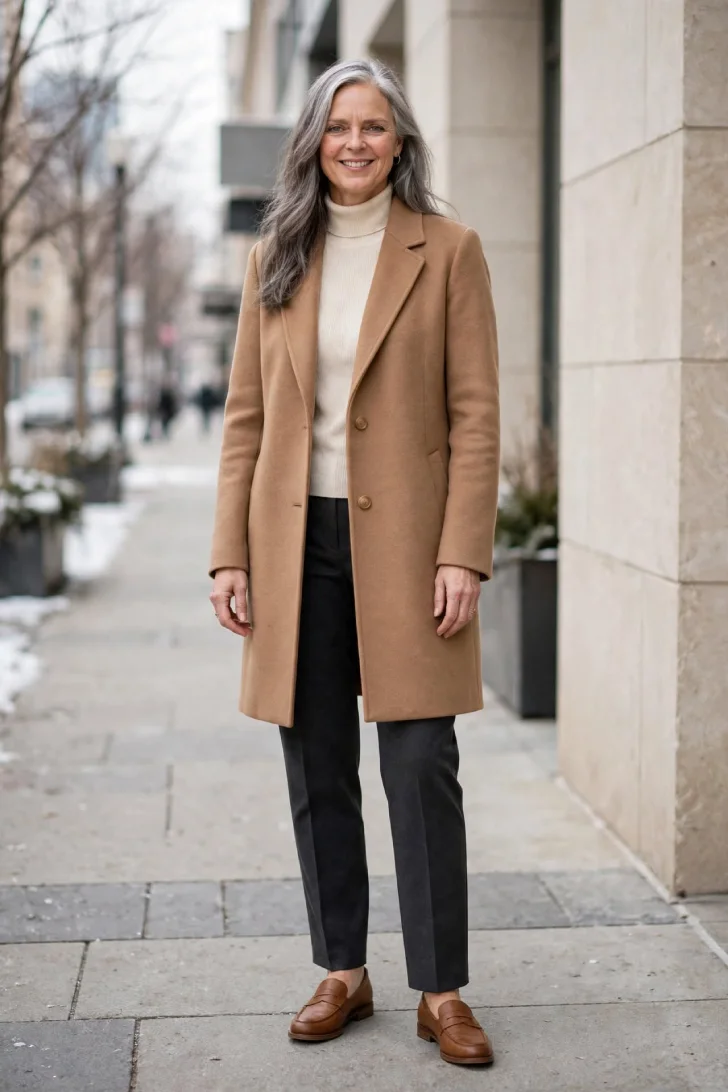
Tiny rule: the shoulder seam should land right at the edge of your shoulder bone.
If it droops down your upper arm, the coat looks sloppy no matter how nice the fabric is. If it pulls up toward your neck, you will feel it every time you reach for the car door.
Roll your shoulders forward and back once in the fitting room. A coat that fits there will also let you wear a sweater underneath without a fight. Oversized styles are the exception, since the drop is part of the design, but then the rest of the coat needs to stay close to the body.
💡 Quick Tip
Bring your thickest everyday sweater when you shop. Try the coat on over it, then raise both arms. If the coat lifts at the waist or strains across your back, go up a size or pick a different cut.
3. Wear Slim Layers Under a Roomy Coat Instead of Chunky Ones
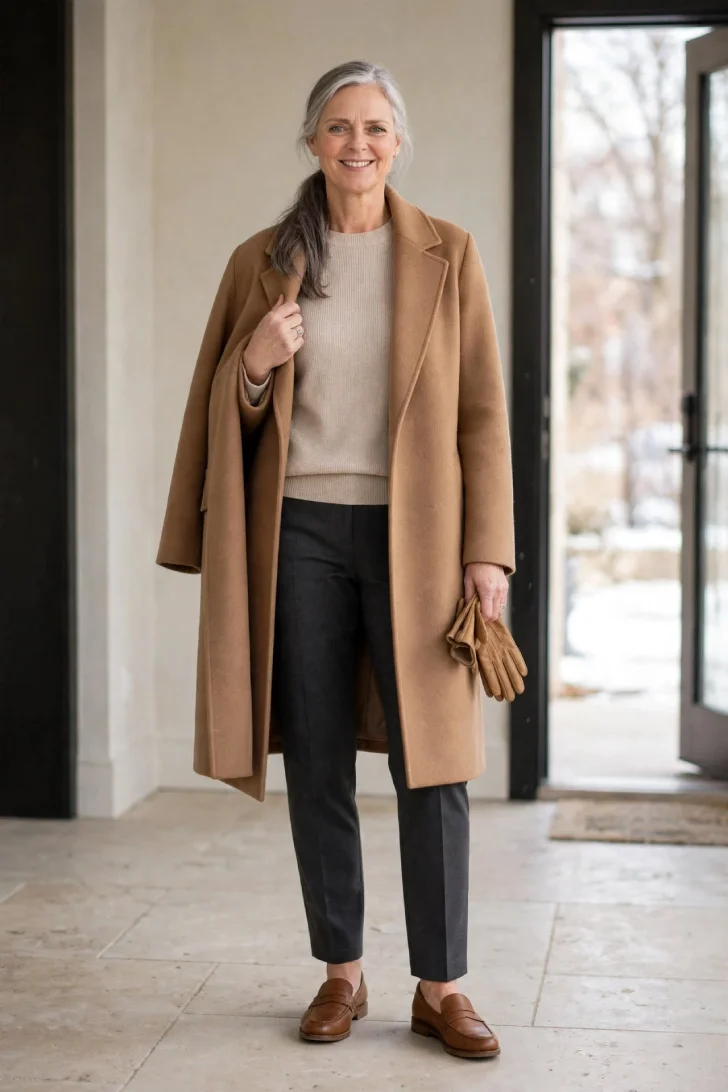
Most winter bulk is hiding under the coat.
A thick cable knit looks cozy on its own, but it adds inches everywhere once a coat goes over it. Keep the coat roomy and the layers thin, so the coat can drape instead of strain. Slim layers that work hard:
- A fine merino sweater
- A fitted thermal tee under a button-up shirt
- Thin fleece-lined leggings under trousers
Save the chunky knit for days you skip the coat. Thin layers hold warmth well, and they leave your coat room to hang.
A chunky knit, a thick scarf, and a boxy coat with no room left. The sleeves strain and the whole outline looks round.
A fine knit, a slim scarf, and the same coat. The sleeves slide on easily and the coat hangs straight from the shoulders.
4. Belt a Wool Coat at Your Natural Waist

Let the belt do the shaping so the coat does not have to.
A coat with no waist can look like a rectangle. A belt at your natural waist, the narrowest part of your torso, adds shape without squeezing. Wool and wool blend coats hold a belt best. Skip belts on stiff puffers, since they bunch in odd places. If your coat came with a belt you never use, start there.
1
Find your waist by bending to the side. The crease that forms is where the belt belongs.
2
Tie it snug but not tight, with a loose knot or a simple buckle.
3
Ease a little fabric over the belt so the coat blouses softly and nothing digs in.
5. Choose Puffers With Wide Baffles Instead of Tiny Quilting
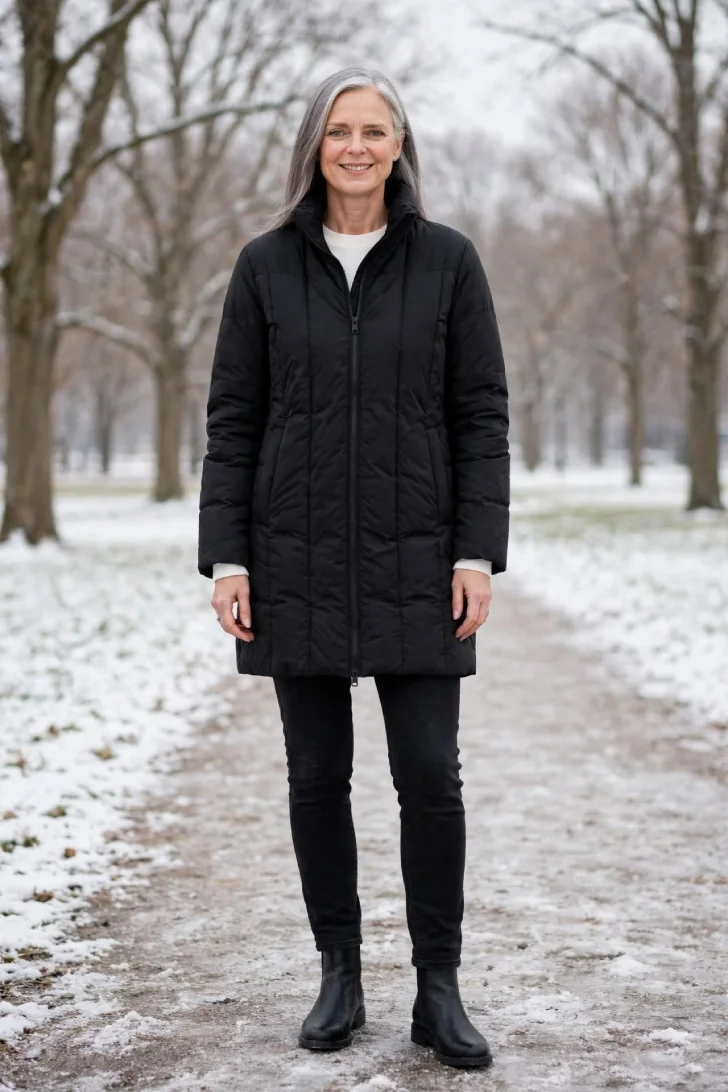
Myth: any puffer will make you look bigger.
The real culprit is usually the quilting. Small, tight rows stack up into rolls around the body. Fewer, wider panels, or vertical channels, draw the eye up and down instead of around. Matte fabric helps too, since a shiny finish catches the light on every curve.
If warmth is your top priority, a streamlined puffer can still be your everyday coat.
| Wide or vertical panels | Tiny horizontal rows |
|---|---|
| Lines flow up and down, so the shape looks smoother. | Stacked rolls wrap around the middle. |
| Works with slim jeans, leggings, or straight trousers. | Needs very slim bottoms to balance the volume. |
| A matte finish keeps the outline quiet. | A shiny finish adds visual volume. |
6. Go One Tone From Neck to Ankle Under a Camel Coat

A camel coat looks best when nothing under it argues with it.
Stick to one color family underneath, such as cream, tan, or soft chocolate. The unbroken line from collar to boots makes you look taller and leaner, and it hides the point where a top meets a waistband. Different textures keep it from looking flat. Try a ribbed knit with smooth trousers, or a silky blouse with wool pants.
Add contrast in one small spot only, like a dark belt or a pair of leather gloves.
7. Swap the Big Scarf for a Slim Wrap at the Neckline
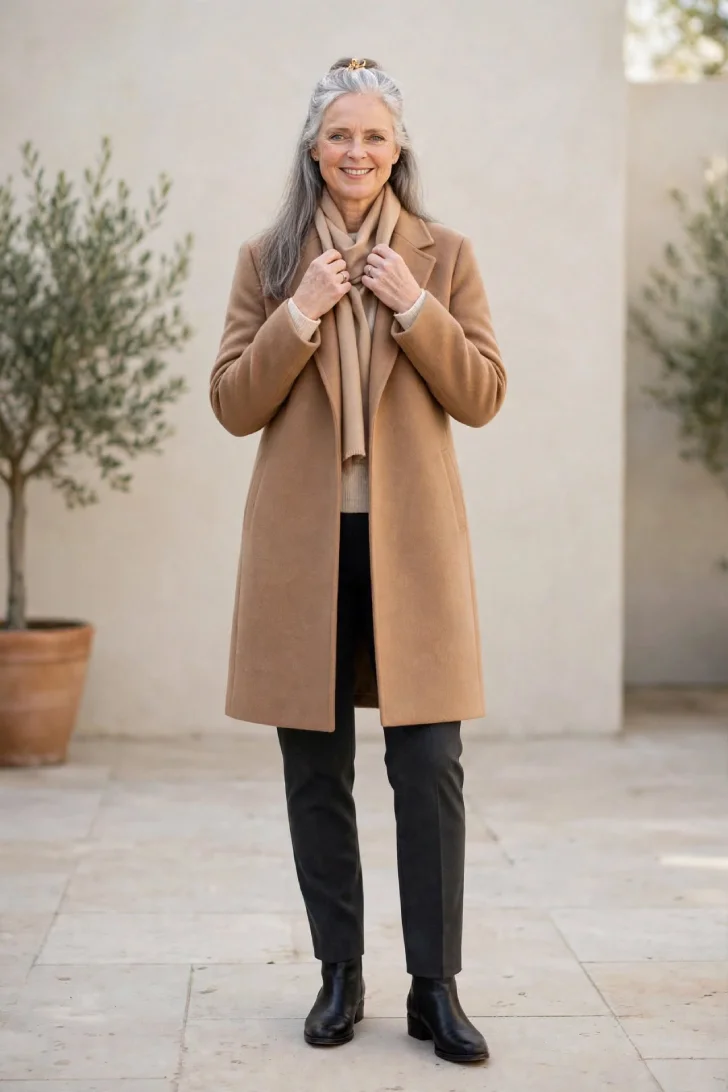
Here is a mistake I see all the time: a huge blanket scarf on top of a thick coat collar.
That pile of fabric sits right under your face and makes your shoulders look wider. A slimmer wrap keeps your neck warm without crowding your frame. Fold it long and narrow, and tuck the ends inside the coat instead of letting them hang.
For very cold days, wear a fine knit scarf under the collar and let the coat do the heavy lifting.
Slim scarf checklist
8. Let Slim Ankle Boots Balance a Long Coat

Long coats look dramatic, but dramatic can slide into heavy.
The fix sits at the other end of your body. A slim ankle boot with a low or block heel shows a little ankle and keeps the bottom half light. Chunky lug soles pull the eye down and add weight, so save them for shorter coats and cropped pants.
Compare it to a bookend. The coat is one side, so the boot has to be the other, not another heavy thing stacked at the floor.
Long coat on top means slim shoe at the bottom. Show a bit of ankle and the whole outfit looks lighter.
9. Choose Fabrics That Drape Instead of Puff Up
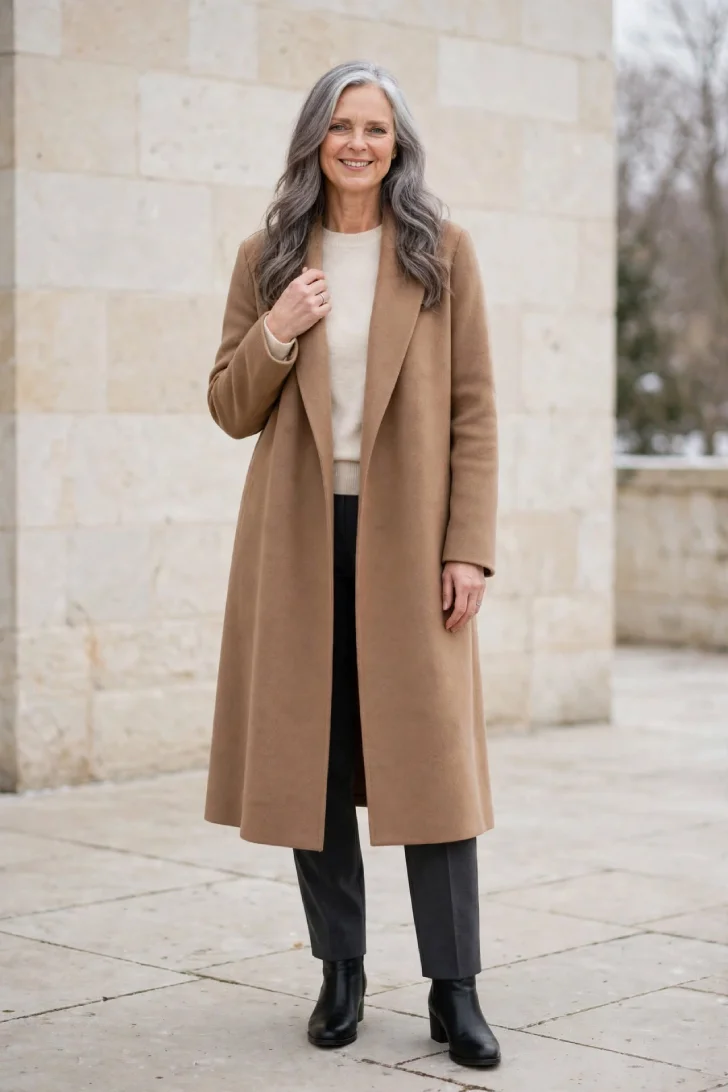
Do a quick hand test in the store.
Hold a fold of the coat fabric in your fist and let go. Fabric that drops softly will hang away from your body. Fabric that springs back stiff will stand out from your frame and add shape you did not ask for. Double-faced wool, soft brushed wool, and crepe blends tend to fall straight. Stiff boucle and thick teddy fleece usually add volume.
The test takes ten seconds. It saves you from a coat that looks lovely on the rack and heavy on you.
The Short Version Before You Head Out the Door
Bulk usually comes from small things. A hem in the wrong spot, a sweater that is too thick, a scarf that is too big. None of that means you need a new coat.
Pick one or two moves from this list and try them with the coat you already own. Often a belt or a slimmer layer is all it takes. Good winter coats outfits for women over 40 come down to shape and balance, and neither one costs much to fix.
Save this list for the next cold morning when you are standing at the closet, wondering what to wear.
Your five second mirror check
📌 Save this to your winter style board so it’s ready the next time you pull your coat out of the closet.